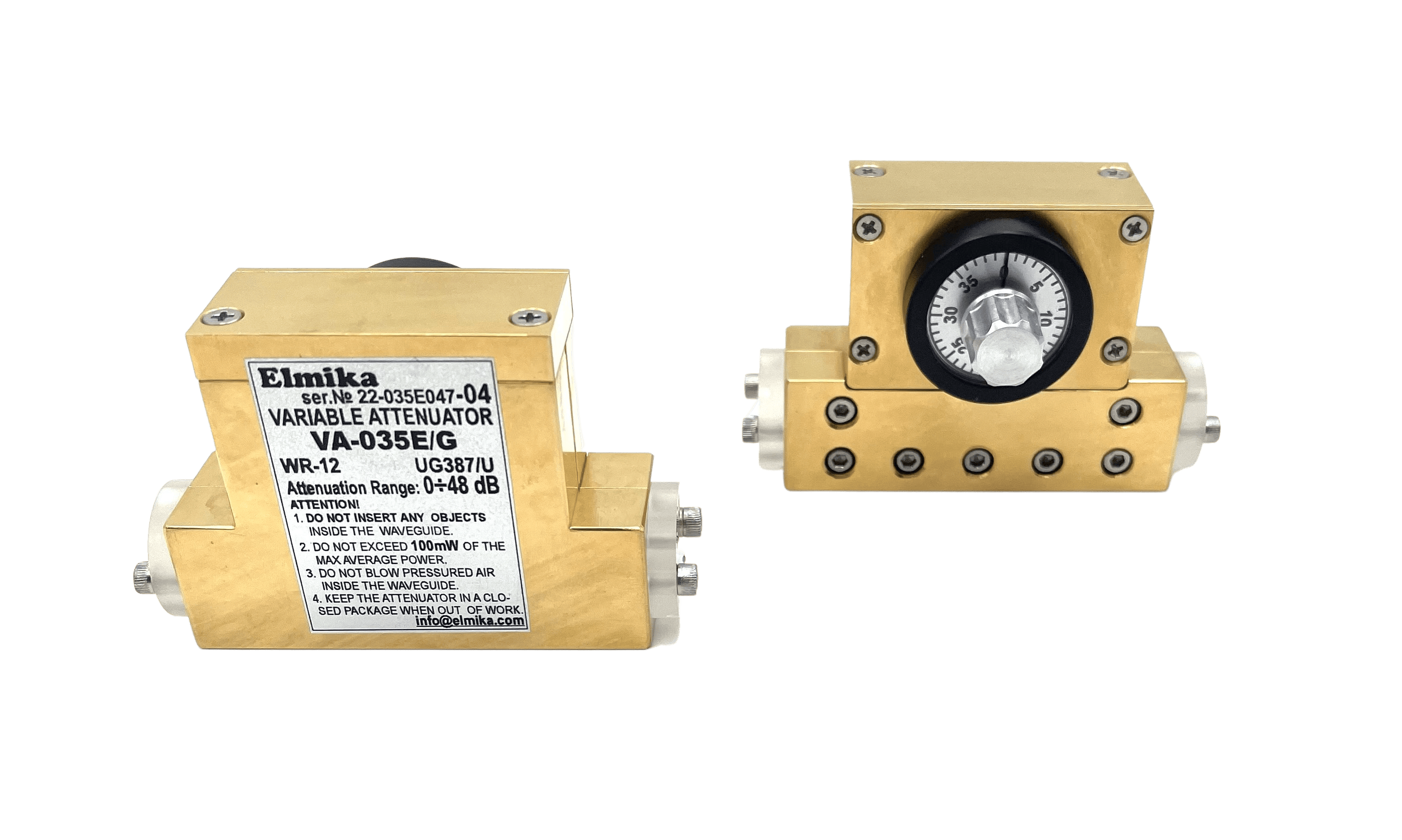
Variable Attenuators up to 325 GHz for Millimeter-Wave Testing
Variable Attenuators operating across millimeter-wave and sub-terahertz frequencies are essential components in modern RF testing and signal conditioning applications. AT Microwave's portfolio extends coverage up to 325 GHz, addressing the growing demand for precise amplitude control in advanced communication systems and measurement instrumentation. These broadband attenuators span from WR28 down to WR3 waveguide standards, providing flexible solutions for frequencies ranging from 26 GHz to beyond 325 GHz.
Technical Specifications
- Frequency Coverage: WR28 to WR3 waveguide configurations, extending up to 325 GHz
- Attenuation Range: Wide dynamic control enabling precise signal level adjustment
- VSWR Performance: Low return loss characteristics maintaining signal integrity
- Insertion Loss: Minimized throughout the operational bandwidth
- Configurations: Full waveguide bandwidth versions optimized for each frequency band
- Control Interface: Compatible with standard laboratory and automated test systems
Application Areas
- SATCOM Systems: Signal level management in satellite communication equipment and payload testing
- Defense & Aerospace: Precision attenuation for radar calibration and electronic warfare applications
- 5G/6G Development: mmWave and sub-terahertz component characterization and validation
- Component Testing: HPA and LNA linearization, compression point determination, and gain measurement
- Research Institutions: High-frequency material characterization and propagation studies
The low VSWR and insertion loss specifications ensure minimal signal degradation, critical when working with sensitive measurements or high-power conditioning applications. Engineers can maintain measurement accuracy while achieving repeatable attenuation across the entire operational range.
As a specialized European RF and mmWave distributor, bq-microwave provides complete technical support for AT Microwave variable attenuators. Detailed performance data, waveguide interface specifications, and application notes are available for each frequency band to facilitate rapid system design and deployment.