The short answer
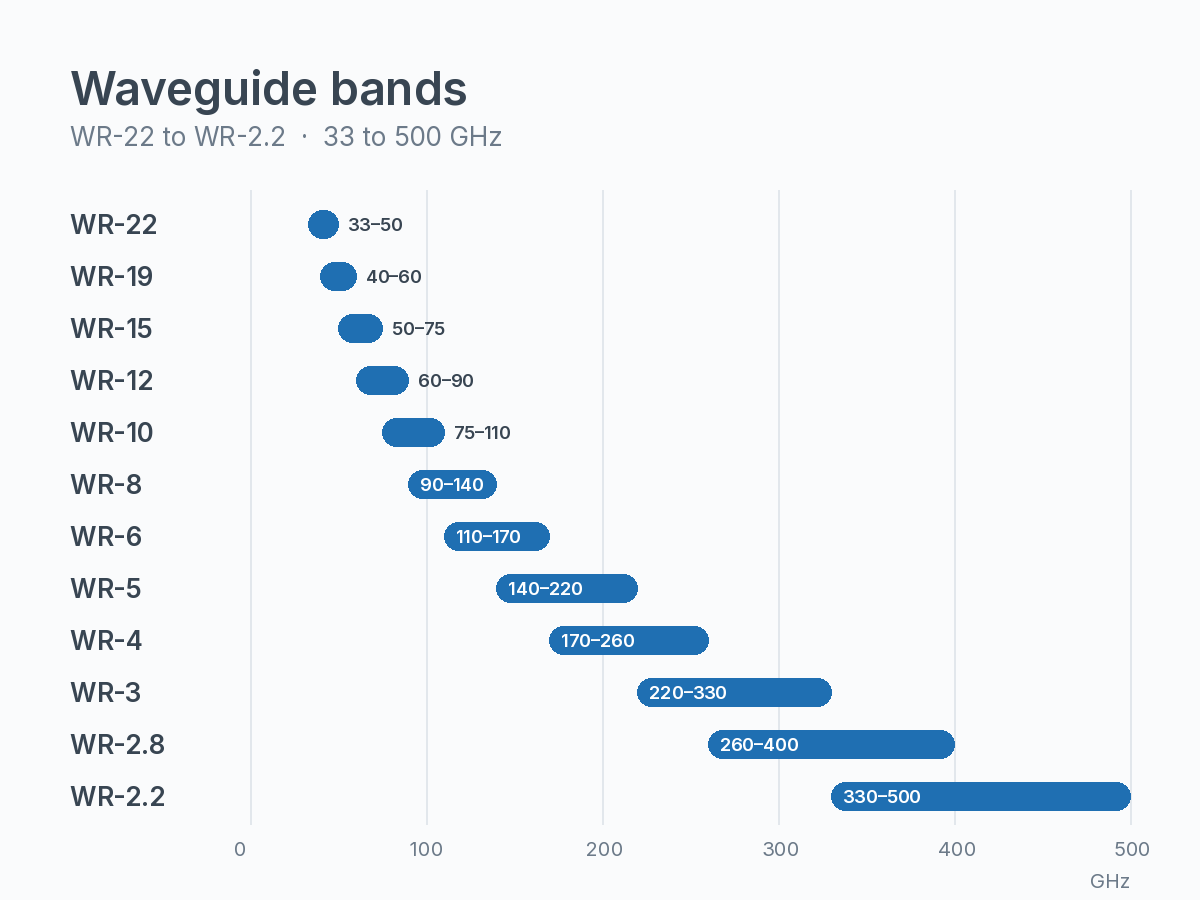
Each rectangular waveguide band covers a fixed frequency range, for example WR-10 from 75 to 110 GHz or WR-3 from 220 to 330 GHz. The smaller the WR number, the higher the frequency. The number stands for the inner width of the waveguide in hundredths of an inch: WR-10 is therefore 0.100 inch (2.54 mm) wide.
| WR | Frequency (GHz) | Inner dimensions (mm) |
|---|---|---|
| WR-22 | 33–50 | 5.69 × 2.84 |
| WR-19 | 40–60 | 4.78 × 2.39 |
| WR-15 | 50–75 | 3.76 × 1.88 |
| WR-12 | 60–90 | 3.10 × 1.55 |
| WR-10 | 75–110 | 2.54 × 1.27 |
| WR-8 | 90–140 | 2.03 × 1.02 |
| WR-6 (6.5) | 110–170 | 1.65 × 0.83 |
| WR-5 (5.1) | 140–220 | 1.30 × 0.65 |
| WR-4 (4.3) | 170–260 | 1.09 × 0.55 |
| WR-3 (3.4) | 220–330 | 0.86 × 0.43 |
| WR-2.8 | 260–400 | 0.71 × 0.36 |
| WR-2.2 | 330–500 | 0.57 × 0.28 |
How to read the WR designation
WR stands for Waveguide Rectangular. The number is the inner width in hundredths of an inch: WR-10 measures 0.100 inch, WR-2.2 only 0.022 inch (0.57 mm). For these standard sizes the inner height is half the width. The smaller the cross-section, the higher the usable frequency range.
Why WR-3 and WR-3.4 are the same
For the smaller sizes two notations are common: the exact designation (WR-6.5, WR-5.1, WR-4.3, WR-3.4) and a shortened one (WR-6, WR-5, WR-4, WR-3). Both refer to the same waveguide. Datasheets and model numbers, for example from AT Microwave, often use the short form.
Be careful with letter bands
Names such as E-band, W-band, D-band or J-band are convenient, but not all manufacturers use them the same way. Only the WR designation together with the frequency range is unambiguous. When requesting quotes or ordering, always state both.
Matching products for your band
From AT Microwave we offer frequency extenders for VNA, spectrum analyzer and signal generator as well as up/down converters up to WR-2.2 (500 GHz), and waveguide cal kits from WR-19 to WR-3. Which product is available in which band is shown in the overview in our frequency extension catalog. Beyond that, we supply waveguide components up to 1700 GHz. If you need help choosing, get in touch with us.
Frequently asked questions
Which waveguide for 110 to 170 GHz?
For 110 to 170 GHz (often called D-band) WR-6 is used, exactly WR-6.5, with inner dimensions of 1.65 × 0.83 mm.
Which waveguide for 75 to 110 GHz?
For 75 to 110 GHz (often called W-band) WR-10 is the standard, with inner dimensions of 2.54 × 1.27 mm.
What does WR-2.2 mean?
WR-2.2 is the rectangular waveguide for 330 to 500 GHz. Its inner width is 0.022 inch, which is 0.57 mm.