The short answer
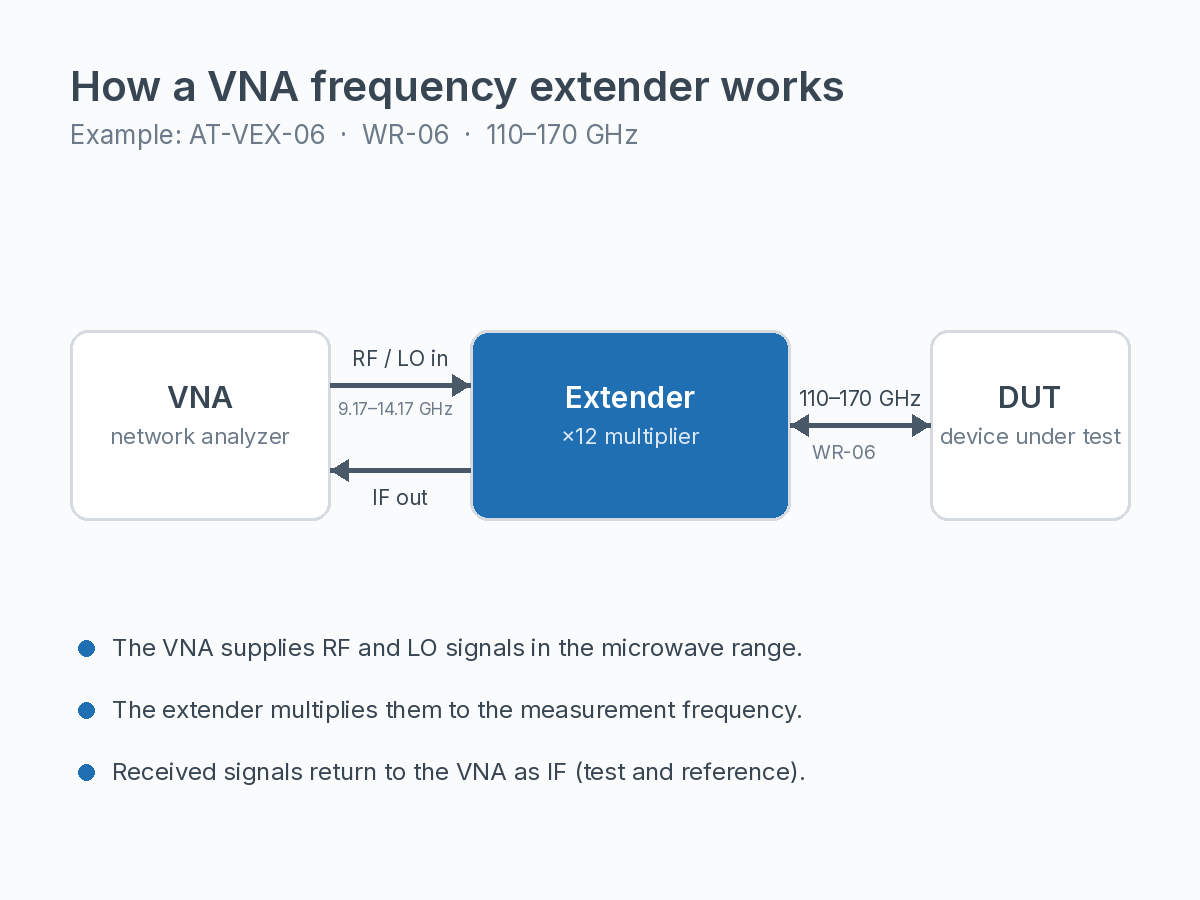
A VNA frequency extender is an external module that extends the measurement range of a vector network analyzer (VNA) into higher frequency bands, with AT Microwave up to 500 GHz. The network analyzer supplies signals in the microwave range, the module multiplies them to the measurement frequency and returns the received signals to the analyzer as an intermediate frequency.
How a VNA frequency extender works
Taking the AT-VEX-06 from AT Microwave for 110 to 170 GHz as an example: the VNA feeds the module with an RF and an LO signal between 9.17 and 14.17 GHz. A 12x multiplier inside the extender turns this into the measurement frequency of 110 to 170 GHz, which reaches the device under test through the WR-06 waveguide port. The returning signals are converted back in the module and passed to the network analyzer through the IF outputs (test and reference), where they are evaluated as usual.
One extender per waveguide band
Because the extenders connect to the device under test through waveguide, each module only works in one specific waveguide band. If you want to measure from 75 to 170 GHz, for example, you need extenders for WR-10 and for WR-6. Which waveguide belongs to which frequency is shown in our article Which WR size for which frequency?
Which configuration do you need?
An extender system consists of transmit and receive parts. Depending on the measurement task, AT Microwave offers different configurations:
| Option | Measurement | S-parameters |
|---|---|---|
| FTFR | Full two-port measurement | S11, S21, S12, S22 |
| FTSR | Transmission and reflection | S11, S21 |
| STSR | Transmission only | S21 |
A full two-port measurement with all four S-parameters requires two extender modules, one at each port.
Calibration
Measurements are made at the waveguide flanges of the extenders. Calibration is therefore done with a waveguide cal kit for the respective band. AT Microwave offers matching cal kits for WR-19 to WR-03.
The AT Microwave range
AT Microwave offers 24 VNA extenders from 18 to 500 GHz: one model with a 2.4 mm coaxial connector (18 to 50 GHz) and models for all waveguide bands from WR-19 to WR-2.2, some also as extended and high-power versions. The frequency extenders work with instruments from Rohde & Schwarz, Keysight, Ceyear and other manufacturers. You will find all models in our frequency extension catalog and on the page VNA frequency extenders. If you need help choosing, get in touch with us.
Frequently asked questions
Can I extend my existing network analyzer?
It depends on the network analyzer. To operate with frequency extenders, the VNA must support this, usually through a frequency offset measurement function (Frequency Offset Measurement), which often has to be ordered as an option when the instrument is purchased. The AT Microwave frequency extenders work with instruments from Rohde & Schwarz, Keysight, Ceyear and other manufacturers. We are happy to check whether your existing instrument is suitable based on the model and the installed options.
Do I need separate extenders for each frequency band?
Yes. Each extender has a waveguide port and therefore only works in one waveguide band, for example WR-06 for 110 to 170 GHz.
Up to which frequency are AT Microwave VNA extenders available?
Up to 500 GHz. The highest band is WR-2.2 with 330 to 500 GHz.